 |
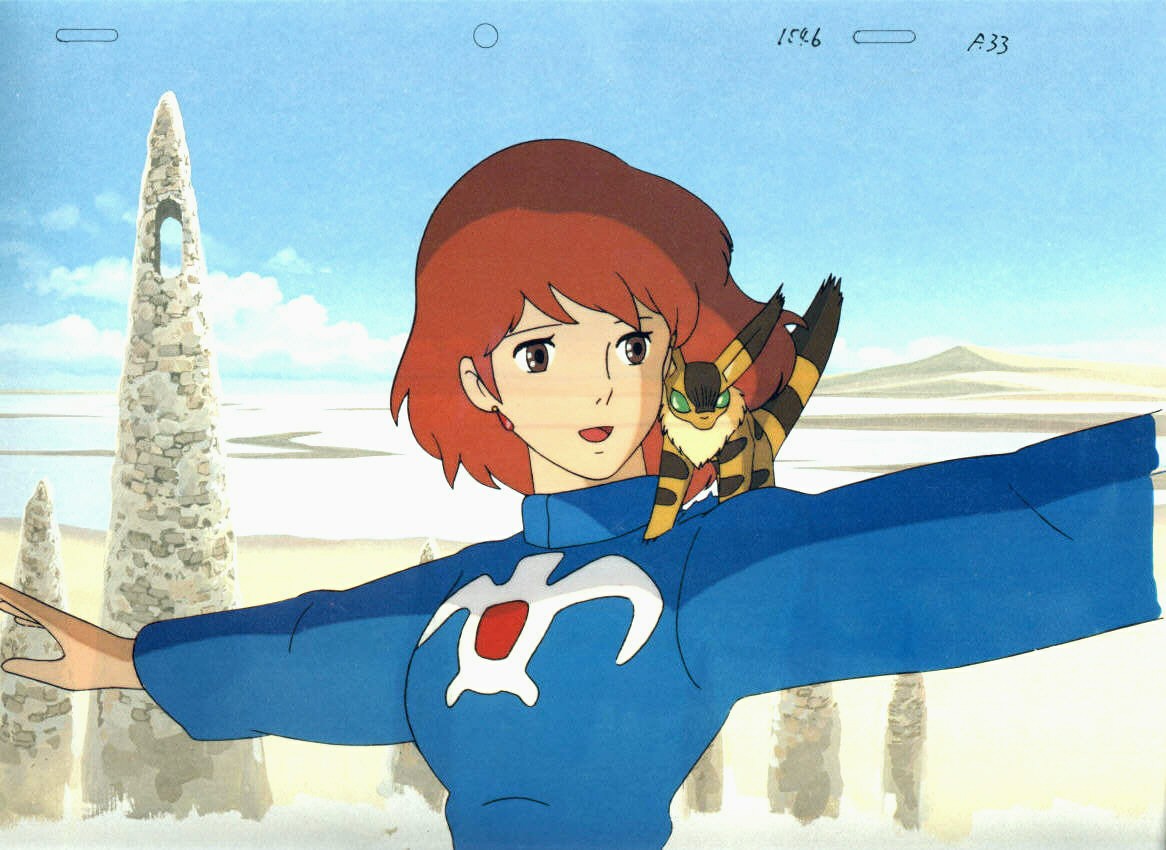
| Naussicaa with her pet...squirrel-thing. |
Monday, April 23, 2012
Coats; Naussicaa

Monday, April 9, 2012
Coats; Princess Mononoke
Princess Mononoke is an epic Japanese historical-fantasy written and directed by the great Miyazaki. In this film, many characters struggle with the existence of good and evil within themselves. Let's look at two specific characters from the film:
San

A quick-witted and fierce princess who was raised in the forest by wild wolf-gods (pretty awesome, I know). Her main focus is protecting the forest and keeping the natural world she lives in safe from outsiders. She is seen as a heroine to the forest because of her protection from the iron-city. However, from the perspective of those who inhabit the iron-city, San is seen as evil villian only trying to destroy the city they've worked so hard to create. A fine example of the contrasting existence of good and evil within San. Next, let's take a look at San's main rival:
Lady Eboshi

I immediately got the evil vibe from Lady Eboshi. Just something about her didn't sit well with me. Anyways, Lady Eboshi is the leader of iron town and is responsible for new iron-based technology, as well as for the contamination of the forest. In iron town, she's seen as a savior and a kind-hearted, accepting woman. She takes in those who are seen as undesirable to society, such as lepers and "working girls", and gives them new purpose in life. On the otherhand, she's also responsible for contaminating the forest with hatred and causing these giant beast-like animal gods to become mad. So of course, she can be seen as a villain from San's perspective, as she is destroying everything that is pure about the forest.
Both of these women demonstrate the existence of both good and evil within themselves that is brought upon by their own personal desires and passions. This story is relavent to every day life, because good and evil exists within all of us and our morals are tired and questioned nearly every day. It's this balance that makes us human, as it is only the gods who are purely good and purely evil.
San
A quick-witted and fierce princess who was raised in the forest by wild wolf-gods (pretty awesome, I know). Her main focus is protecting the forest and keeping the natural world she lives in safe from outsiders. She is seen as a heroine to the forest because of her protection from the iron-city. However, from the perspective of those who inhabit the iron-city, San is seen as evil villian only trying to destroy the city they've worked so hard to create. A fine example of the contrasting existence of good and evil within San. Next, let's take a look at San's main rival:
Lady Eboshi
I immediately got the evil vibe from Lady Eboshi. Just something about her didn't sit well with me. Anyways, Lady Eboshi is the leader of iron town and is responsible for new iron-based technology, as well as for the contamination of the forest. In iron town, she's seen as a savior and a kind-hearted, accepting woman. She takes in those who are seen as undesirable to society, such as lepers and "working girls", and gives them new purpose in life. On the otherhand, she's also responsible for contaminating the forest with hatred and causing these giant beast-like animal gods to become mad. So of course, she can be seen as a villain from San's perspective, as she is destroying everything that is pure about the forest.
Both of these women demonstrate the existence of both good and evil within themselves that is brought upon by their own personal desires and passions. This story is relavent to every day life, because good and evil exists within all of us and our morals are tired and questioned nearly every day. It's this balance that makes us human, as it is only the gods who are purely good and purely evil.
Coats; Grave of the Fireflies
| Image taken from here. |
Coats; Ghost in the Shell
| "Kill all the humans" |
Friday, March 9, 2012
Coats; Giri, Ninjo, and the Burmese Harp
 |
| Mizushima plays a song to his battalion one last time. |
Friday, February 10, 2012
Coats; Perfect Blue
Perfect Blue is one of those movies that really makes your head hurt after a while. It’s a psychological thriller that blurs the lines of dreams and reality while following MIma, the pop-idol from the J-pop group “CHAM!”. As many musicians do at some point in their career, Mima decides to leave the pop-group to become and actress (i.e. Will Smith). Mima manages to land a role in a show called d Double Blind, but this sudden change in persona and image upsets her some of her fan base, even to the point of MIma receiving an anonymous fax calling her a traitor. It also seems Mima has upset her internet fanbase, as she discovered a website called “Mima’s Room”. This website contained very personal information about Mima, as well as diary entries describing her life in great detail. Upset and confused, she turns to her manager Rumi Hidaka for advice. Rumi, being a former pop star herself, advises Mima to just ignore the website. Mima continues on with her acting career on the set of Double Blind, and even lands a larger part on the show; the part however, is of a rape victim at a strip club. Rumi insists that Mima turn down the part, saying that it would ruin her reputation. Mima, however, ignores her manager’s wishes and accepts the role. As the scene is filmed, it is apparent that Mima is traumatized by the intensity of what is being film, so much that she begins to blur what is real and what is not. Now, I’d like to talk about a few things here.
 |
| This image was taken from here. |
First off, this film comments on some of the problems in the film industry, related women and what they “have to do” to become famous in that industry. Mima becomes so desperate in her aspirations to become a famous actress, that she subjects herself and her previous reputation to that of a rape victim because she thinks that will jump start her career…or something. Now, I’m not a woman, but I personally find that to be slightly degrading, that the girl would rather fake a rape scene rather than actually be good at acting on camera. This also leads to another issue the film comments on, and that is the idolization and commodification of celebrities. In today’s society, this issue is very prominent with the constant monitoring of celebrities through paparazzi, twitter, magazines, online articles, news coverage, etc. It seems that most of the world today is more worried about the image and lives of their favorite celebrities, rather than their own lives. And that leads to the last issue this film touches on: the loss of personal identity and self-image. In the film, Mima loses touch with her perception of reality once she makes the jump from small film actress to a leading role rape victim. Then, when she discovers that her online identity has become further tarnished through the website “Mima’s Room”. She becomes distraught and begins to lose her sanity and can’t tell when she’s dreaming or when she’s awake. It isn’t until the end of the film that she discovers her manager Rima is the mind behind her false-self, and of course, they battle. Mima overcomes Rima, and Rima is sent away to a mental facility. Mima is then left to live her life on her own, and begins to regain control of her sanity and self-image.
Friday, January 27, 2012
Coats; Ninja Scroll
 Ninja Scroll, the 1994 feature anime movie, takes place during the time of feudal Japan, where the samurai and ninja warrior reined supreme. The story follows the adventures of a wandering ninja named Jubei Kibagami, and a female ninja counterpart, Kagero. Not long into the film, Jubei is poisoned by, and therefore forced into helping, a small, crazed Buddhist monk named Dakuan (later we learn he is actually a government spy). Basically, the story boils down to Jubei and Kagero helping this crazy little monk fellow hunt out and kill the Devils of Kimon so that they may find the gold mines the Tokugawa are searching for. Dakuan, being a spy for the Tokugawa shogunate, uses Jubei and Kagero to fight off the Devils of Kimon while he conducts the main investigation on his own. However, during these battles with the Devils, Kagero is abducted by the Devil, Shijima. Shijima posses Kagero, and forces her to fight Jubei when he arrives to rescue her. Jubei, however, quickly disposes of Shijima. Once the group is reunited, they attempt to stop the remaining Devils of Kimon from transporting the gold via ship to the Shogun of the Dark, but in their attempts Kagero is fatally wounded. (oh no!) Jubei quickly rushes to her side to hold her in her last moments of life. Kagero, in her few final moments, confesses her love to Jubei, the two kiss (curing Jubei’s poison), and she then passes away. Enraged, Jubei hacks and slashes through the enemy forces, boarding the ship before it departs. Dakuan also makes it on to the ship, and overhears Toyotomi retainer and Gemma discussing their true intentions for the gold. The Toyotomi explains the plans to use the gold to purchase advanced weapons from Spain, while Gemma on the other hand, plans to use the gold for himself to raise the ultimate ninja army. Gemma then kills the Toyotami retainer, and takes control of the ship. Meanwhile, Jubei and Dakuan are in the hold of the ship, and in a battle with Zakuro, set the ship aflame. Gemma confronts Jubei, and the two have a final clash. In an ironic turn of events (as it so commonly happens in anime), Gemma falls into a pool of molten gold, and dies. Jubei and Dakuan manage to escape the ship before it sinks completely, thus ending their epic journey.
Subscribe to:
Comments (Atom)